How we measure slot RTP at Canadian online casinos
How we manually collect, verify and track slot RTP data across the casinos in our Canadian database.
How we measure slot RTP
The RTP figures on Casino-RTP come from our own manual checks. We access the casinos in our database, launch the games and find the RTP stated inside each slot’s help or information files. Those observations are recorded in our database and used to compare individual slots as well as casinos as a whole.
It takes a lot of manual work. It is also the foundation of our RTP data.
We deliberately go much broader than checking a handful of major slots and treating them as a sample. A larger selection gives us more useful data for comparing casinos, but there is another reason for doing it. Someone looking for one particular slot they actually play should have a reasonable chance of finding it in our database and comparing the RTP we observed at different casinos.
Our measurements in numbers
The Canadian database currently covers 141 slots from 10 studios at 20 casinos. Everything below comes from one documented measurement, carried out between April 1 and April 24, 2026.
In that measurement we checked 2,798 slot and casino combinations. We found an RTP value in 1,526 of them. In the other 1,272, the game was not available at the casino when we checked. The remaining 22 of the 2,820 possible combinations were not checked.
Game availability varies a lot between the casinos in the Canadian dataset. The number of tracked slots we found at a single casino ranged from 28 to 135.
At roughly 30 to 40 seconds per check, the game checks alone correspond to approximately 23 to 31 hours of work, before logins, loading times and rechecks.
How we check a slot’s RTP
Each slot is checked manually at every casino included in the measurement.
We find the game, launch it and open its help or information files. Studios organize this information differently, although games from the same studio tend to follow a similar structure.
We identify the RTP for the base game and record the value displayed there. Some slots also show separate RTP figures for bonus features or other modes. Our database uses the base-game RTP.
We follow the same source principle across the casinos we compare. If RTP is also displayed elsewhere on a casino site, we still use the value identified inside the game rather than mixing different sources from one casino to another.
An individual check can be fairly quick once the process is underway. Repeating it across thousands of game and casino combinations is what creates the workload. Switching casinos, accessing accounts, loading games and rechecking unusual values all add time on top of the individual checks.
Why do we check RTP inside the games?
A slot does not necessarily have one universal RTP.
Studios can release the same game in several RTP configurations and casinos can use different versions. The RTP commonly advertised for a game therefore does not necessarily tell you which configuration is being used at a particular casino.
That is why our measurements come from the games themselves.
If we find different RTP configurations for the same slot, we record the value observed at each casino. This lets us compare casinos while also following one particular game across multiple operators.
How we choose which slots to track
We do not want the entire database to depend on a small sample of the biggest games. Casino-RTP should also be useful when someone wants to look up a particular slot they play.
The database therefore includes major, widely played titles alongside a much broader selection of relevant games. Search demand, market knowledge and information about actual game popularity all help determine which games we prioritize.
We also follow new releases and add titles as they become relevant.
The goal is not to catalogue every slot in existence. We want a large, useful selection that gives us a solid base for comparing casinos while also making RTP information available for far more individual games than a small sample could cover.
Which casinos do we include?
Our Canadian database covers the casinos selected for the Canadian version of Casino-RTP according to the market scope of the site.
Relevant new casinos are added as the database grows and as we are able to complete the necessary checks. Casinos that are no longer relevant to the current comparison can be removed from the live listings while their historical observations remain in our underlying data.
We also treat separate casino brands separately when they share the same operator or corporate group. RTP configurations can differ between brands, so combining them could hide differences that matter to players.
Inside our RTP database
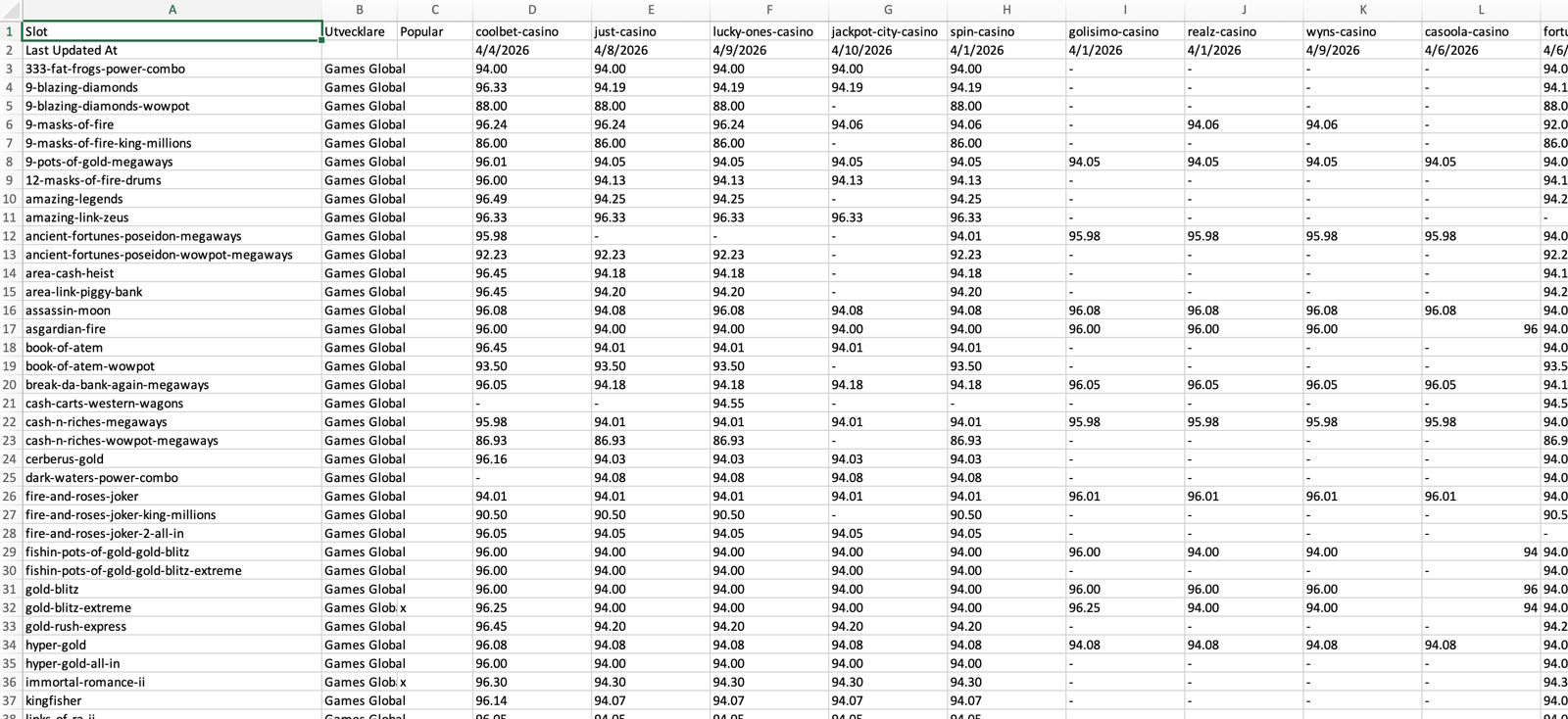
Example from our April 2026 Canadian measurement. The image shows how games and casinos are organized in our working data. Values on our live pages may change after later checks, so the image should not be used to read current RTP.
Each documented measurement is stored separately. Slots are arranged by row and casinos by column. This lets us compare the same game across different casinos and look back at what was recorded during an earlier measurement.
A numerical RTP value means we checked the game and observed that RTP.
A dash means the combination was checked but the game was not found at the casino during that measurement.
A blank cell means the combination was not checked.
Those last two states are not interchangeable. We never treat an unchecked combination as evidence that the casino did not offer the game.
How we calculate a casino’s average RTP
A casino’s average RTP is calculated from all valid RTP values we observed for the checked games available at that casino.
Every observed slot has equal weight:
Average RTP = sum of observed RTP values / number of slots with an observed RTP
Individual games are not weighted according to popularity.
Slots with the same fixed RTP across casinos are included as well. They are still part of the games available to players and therefore belong in the overall average.
We also do not insert hypothetical RTP values for games or studios a casino does not offer. If a casino does not carry a studio whose games tend to have lower RTP, we do not penalize that casino by assigning it games its players cannot access.
This means that two casino averages will not always contain an identical set of slots. The figure should be understood as the average RTP we observed across each casino’s checked game selection, rather than a controlled comparison that forces every casino into an identical game catalogue.
Tracking RTP over time
A new measurement does not overwrite the previous ones.
Every documented check remains a separate snapshot. That lets us identify cases where the RTP of a game changes and follow how differences between casinos develop over time.
If a slot had a numerical RTP during an earlier check but is no longer found at the casino during a later measurement, the earlier observation stays in the historical dataset. The later measurement records the new status.
Historical values describe what we observed at the time. They should not be read as a claim about the RTP being used today.
How we check the data for errors
Manual collection lets us see what is actually displayed inside the games. With thousands of individual checks, it also means we need to look actively for possible data-entry errors.
After a measurement, we analyse the RTP levels recorded for each slot, the size of the differences between those levels and how many casinos use each configuration.
Unusual values get another look. If only one casino has a particular RTP level, for example, or two recorded levels are suspiciously close, we manually recheck the observation. Where possible, we also compare it with official studio information about the RTP configurations available for that game.
Casino-RTP is run by two people. The RTP measurements are primarily carried out by one of us, while the other handles much of the technical development and performs spot checks on the data.
What if we find an error?
If we establish that a recorded value is wrong, we correct it.
Depending on the type of error, we may also recheck related observations instead of changing only one value. That could mean checking other games from the same studio at the same casino. If the error has already affected published information, we update the relevant page and disclose the correction where it is useful to readers.
Casinos and readers are welcome to flag something that looks wrong. We do not change an RTP observation simply because someone asks us to. We verify it ourselves first.
If you think you have found an error in our data, please let us know through our Contact Us page.
Do affiliate relationships affect our RTP rankings?
Casino-RTP is affiliate-funded. The compensation we receive from different casinos does not determine the RTP values in our database or the order of casinos when they are ranked by RTP.
Different partnerships can have very different economic value to us. A less profitable partnership can still rank above a more profitable one if its measured RTP is higher.
We do not move casinos up an RTP ranking because we earn more from them.
The same principle applies to the underlying data. A casino is welcome to flag a value it believes is incorrect, but our RTP data is not for sale. A commercial relationship cannot buy a different RTP value or a better position in an RTP-based ranking.
What our RTP measurements can tell you
Every RTP measurement is a snapshot. A casino can change a game’s configuration after we check it. Games can also be added, removed or temporarily unavailable. This is why we keep measurement dates and return to the same games and casinos over time.
RTP itself is a theoretical return calculated over a very large number of game rounds. A slot with 96.00% RTP does not mean an individual player will receive $96 back from every $100 wagered during a particular session.
Our job is more specific. We document the RTP we actually find in the games, make those observations comparable and track how they change over time.
That data is the basis for the RTP information published across Casino-RTP.